

Articles
Phuket Boat Charter Guide & Prices

Boat Charters in Phuket
If I want the short answer: a Phuket boat charter is best when I match the route, season, boat type, and budget before I book. Most day charters run about 8 hours, sunset trips about 3–4 hours, and Similan trips need 2+ nights. High season is usually November to April, while May to October brings rougher seas and route limits. Prices often start around $1,300+ per day for a private charter, with park fees and 7% VAT often added.
Here’s the full picture in plain English:
- Best time: November to April for calmer seas and clearer water
- Best green-season route: Phang Nga Bay
- Best short swim/snorkel route: Racha Islands
- Best big-name route: Phi Phi Islands
- Best slow route: Koh Yao Noi / Koh Yao Yai
- Best multi-day route: Similan Islands, open about October 15 to May 15
- Main departure points: Ao Po, Royal Phuket Marina, Chalong, Yacht Haven, Boat Lagoon
- Main boat types: motor yachts, catamarans, sailing yachts, and dive liveaboards
- Watch for extras: park fees, fuel outside the planned route, VAT, drinks, transfers, and APA on multi-day trips
A few rules matter right away:
- Maya Bay usually closes in August and September
- Jet skis are banned in marine park areas
- Similan Islands close during the monsoon period
- Captains may change the route if weather shifts
If I were planning this trip, I’d start with one question: Do I want a calm sightseeing day, a swim-and-snorkel day, or a multi-night trip? That one choice usually decides the marina, boat, timing, and price.
| Route | Usual Trip Length | Best For | Notes |
|---|---|---|---|
| Phang Nga Bay | Full day | Caves, hongs, kayaking, calmer water | Strong pick in wet-season months |
| Phi Phi Islands | Full day or overnight | Famous beaches and scenery | Busier; crossing can be rough |
| Racha Islands | Half day or full day | Swimming and snorkeling | Clear water, shorter run |
| Koh Yao Noi / Yao Yai | Full day or overnight | Quiet anchorages, slow cruising | More laid-back than Phi Phi |
| Similan Islands | 2+ nights | Diving and remote reefs | Seasonal access only |
In short, Phuket works well for private charters because you can shape the day around your group instead of following a shared-boat schedule. The main job is picking the right route for the sea conditions, then making sure the quote covers the full cost.
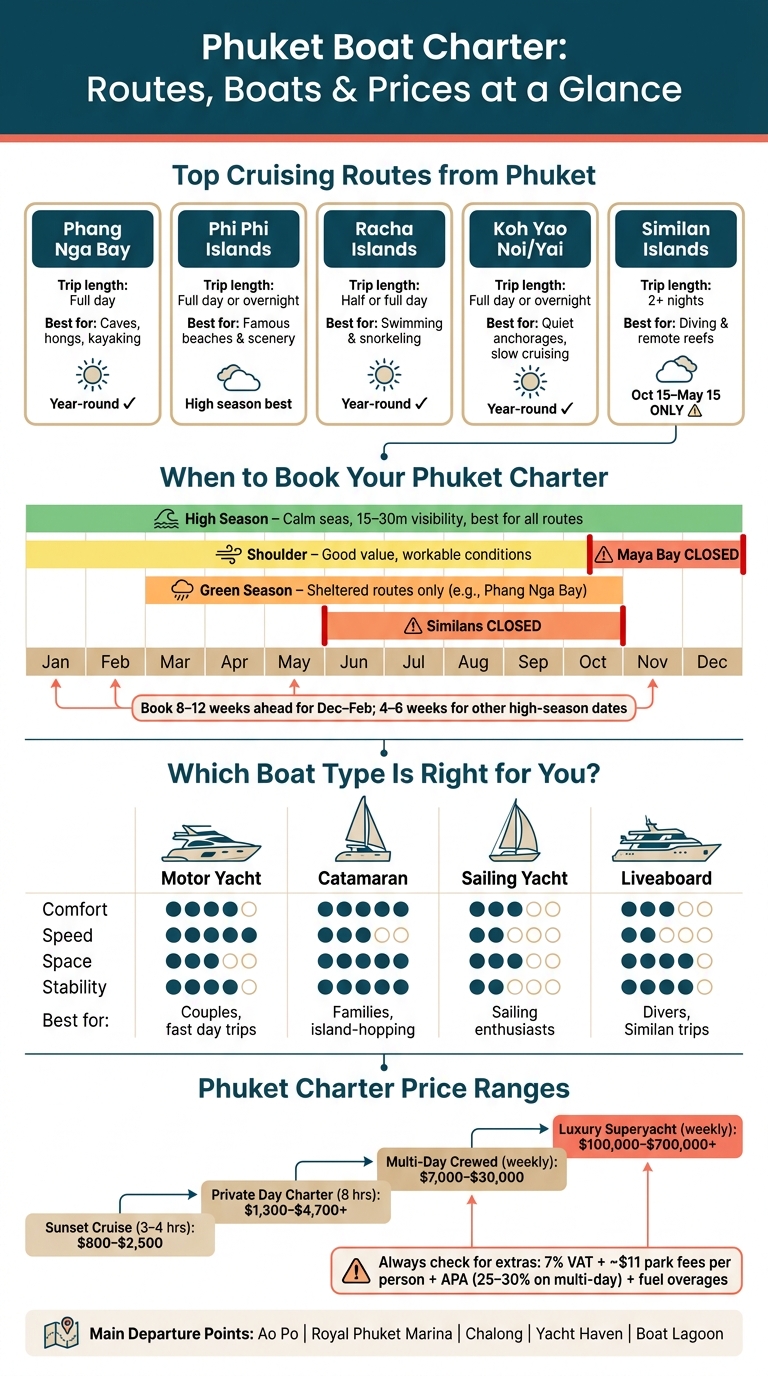
Phuket Boat Charter: Routes, Boats & Prices at a Glance
Best time to book a boat charter in Phuket
Phuket charters run around two monsoon seasons: the northeast monsoon from November to April and the southwest monsoon from May to October. Your best pick depends on three things: sea conditions, the route you want, and what you’re willing to spend.
High season: November to April
This is the most dependable time for a Phuket boat charter. The northeast monsoon usually brings calmer seas, lighter winds, and clearer water. That makes swimming, snorkeling, and island-hopping a lot more comfortable. Visibility often reaches 15 to 30 meters [1].
The busiest period falls between December and February [3]. If you’re planning for Christmas or New Year, book 8 to 12 weeks ahead. For other high-season dates, 4 to 6 weeks is usually enough [1]. This season works best for first-time guests, families, and premium multi-day trips where comfort and steady conditions matter most.
Green season: May to October
From May to October, the southwest monsoon brings more rain and stronger swells [6][7]. In plain English, that means route planning matters more than ever. Captains usually move toward sheltered waters and shorter crossings to keep the day smoother.
There’s one rule you don’t want to miss: the Similan Islands are closed each year during the monsoon window, roughly from mid-May to mid-October [4][5]. If the Similans are high on your list, plan your trip during the open season. Phang Nga Bay is the best sheltered choice because it stays open all year [2].
Shoulder months: balancing conditions and cost
The shoulder periods, especially late October into early November and March into April, can hit a nice middle ground for weather and price [8][9]. Conditions are often still workable on protected routes, and rates are usually lower than during peak high season. These months make sense for travelers who want better value and don’t mind planning around workable-weather dates.
Once you’ve chosen the season, the next move is picking the best departure point for your route.
Where to cruise from Phuket
From Phuket, you can reach a few very different cruising areas. Most of the best-known spots are close enough for a day trip. The Similan Islands are the outlier. That trip takes more time, more planning, and a boat built for longer runs.
The best route usually comes down to four simple things: how much time you want on the water, what you want to do, who you’re traveling with, and the time of year. The routes below go from easy day trips to the longest multi-night option.
| Destination | Trip Length | Main Activities |
|---|---|---|
| Phang Nga Bay | Full day | Limestone scenery, caves, hongs, kayaking |
| Phi Phi Islands | Full day or overnight | Beaches, snorkeling, scenic anchorages |
| Racha Islands | Full day or half day | Swimming, snorkeling, short passage |
| Koh Yao Noi and Koh Yao Yai | Full day or overnight | Quiet anchorages, village scenery, slow cruising |
| Similan Islands | 2+ nights | Diving, snorkeling, remote nature |
Start with the route that fits your pace. Then you can match the right boat in the next section.
Phang Nga Bay
Phang Nga Bay sits about 15 nautical miles northeast of Phuket, or around a 1 to 1.5-hour cruise [3][2]. The water here is usually sheltered and calm, which makes the bay a strong pick for caves, hongs, and kayaking.
This is often the easiest route for families, first-time charter guests, and groups that want sightseeing without a long crossing in open water. It also makes a lot of sense during the green season, when offshore conditions can shift and day plans need a bit more caution.
Phi Phi Islands, Racha Islands, and Koh Yao
These three routes may sit in the same general region, but they feel very different on the water.
Phi Phi is the classic Phuket route. It sits about 25 nautical miles southeast, with a crossing of around 1.5 to 2 hours [3][2]. You go for the big scenery: white-sand beaches, turquoise bays, and famous stops like Maya Bay and Pileh Lagoon. The flip side is simple – it’s busier, and the open-sea passage can get choppy outside high season. Maya Bay access also changes by season, so check the latest conditions before you lock in a Phi Phi plan.
Racha Islands give you a shorter and often calmer run, usually 1 to 1.5 hours from Phuket [10][11]. The water here is some of the clearest you’ll find on a day-charter route. Racha Yai is usually the better fit for swimming and snorkeling. Racha Noi feels more remote, with exposed anchorages and conditions that suit experienced divers better. If your group cares more about getting in the water than packing in sightseeing, Racha is often the better call.
Koh Yao Noi and Koh Yao Yai sit in the sheltered channel between Phuket and Phang Nga Bay, which makes them easy to reach and well suited to slow cruising [10][11]. You won’t find big resort crowds here. What you do get is quiet anchorages, local fishing villages, and a calmer pace.
Similan Islands for multi-day trips
The Similan Islands are not a casual day trip. This route calls for an overnight or multi-night charter.
The islands sit about 84 km (52 miles) northwest of Phuket, and the crossing takes 3 or more hours depending on the boat [12]. Most guests plan for at least two nights, especially if diving is the main reason for the trip [10][12][13].
Visibility underwater often reaches 30 meters (about 100 feet) during the open season [3], and the marine park’s granite boulder formations are a big part of why people make the trip. The main planning point is non-negotiable: the Similan Islands National Park is only open from October 15 to May 15 [12][14]. Outside that period, access is fully closed.
That means you need to line up dates around the park season and confirm the exact opening window for the year before booking. A larger yacht or catamaran with cabins is the right fit here. The passage is too long for a simple day charter, and once you’re looking at the Similans, cabin layout and boat size matter more than pure speed.
For a Phuket boat charter built around the Similans, confirm the park’s open season before you finalize any dates.
Boat types, marinas, and what to expect onboard
Pick the boat based on your route. In Phuket, the four main choices are motor yachts, catamarans, sailing yachts, and liveaboards. Your boat type and boarding point should line up with where you’re going and how many people are coming along.
Motor yachts, catamarans, sailing yachts, and liveaboards
Motor yachts are built for speed and comfort. They’re a strong fit for premium day trips and short overnighters when you want to cover more water in less time. Catamarans lean toward stability and deck space, which makes them a solid pick for families and groups who want an easy island-hopping day. Their twin-hull design cuts down on rolling at anchor, which can make a big difference for kids or anyone who gets seasick.
Sailing yachts give you that classic sailing feel, with wind-powered cruising and a slower rhythm. They work well for guests who care as much about the ride as the stop itself and don’t mind having less deck space than on a catamaran. Liveaboards are the go-to option for multi-day dive trips to the Similans and Surin Islands. They’re set up for the job, with practical cabins, dive decks, compressors, and gear storage.
| Boat Type | Comfort | Speed | Space | Best Routes | Best For |
|---|---|---|---|---|---|
| Motor Yacht | High | Fast | Moderate | Phi Phi, Phang Nga, Racha | Couples, small groups, fast day trips |
| Catamaran | Very stable | Moderate | Very high | Island-hopping, Phang Nga, Koh Yao | Families, groups, relaxed cruising |
| Sailing Yacht | Moderate | Slower | Moderate | Shorter coastal cruises | Sailing enthusiasts, traditionalists |
| Liveaboard | Functional, dive-focused | Slower | High | Similan and Surin Islands, remote reefs | Divers, multi-day expeditions |
Main marinas and boarding points in Phuket
Your boarding point matters more than many people think. It should match the part of the coast you plan to cruise.
- Ao Po Grand Marina: access at any tide; best for Phang Nga Bay
- Royal Phuket Marina: premium access to Phang Nga Bay and Phi Phi
- Yacht Haven Marina: good northern base near the airport
- Boat Lagoon: repair and service facilities; departure times need advance confirmation because of the shallow tidal entrance
- Chalong: best for Racha and Coral Island
Crew, catering, cabins, and water toys
Most crewed charters come with a licensed captain and at least one deckhand. On larger motor yachts and catamarans, you may also have a steward and a chef preparing meals onboard.
For overnight charters, modern catamarans and motor yachts usually include private cabins, ensuite or shared bathrooms, air conditioning, linens, and towels. Liveaboards run on a more fixed schedule, often with early starts and multiple dives each day. That’s a better fit for guests whose main goal is getting out to remote dive sites.
Snorkeling gear, kayaks, and stand-up paddleboards are often included. Some luxury vessels also offer inflatable slides or towable inflatables. Jet skis are restricted in many marine parks, so whether they’re available depends on both the route and the vessel.
Choose speed, space, or range first. That choice tends to shape everything else. Before booking, check the inclusions so the boat fits the trip you have in mind.
To explore the full range of boats available for a Phuket boat charter – from day-trip catamarans to multi-night liveaboards – check the current fleet and confirm what’s included before you book.
Pricing, booking, and rules to know before you go
Once you’ve picked your route and boat type, the last moving parts are price and park rules.
How charter pricing works
In Phuket, charters usually follow one of two pricing setups.
Day trips are often sold as an all-in package. Multi-day charters usually use a base rate plus an Advanced Provisioning Allowance (APA). The APA is often 25–30% of the base charter fee and covers fuel, food, marina fees, and crew gratuity.
Most charters include the yacht, a professional crew, standard fuel for a set route, drinking water, soft drinks, seasonal fruit, and basic water toys like snorkeling gear. Common add-ons include 7% VAT, national park entry fees of about 400 THB ($11) per person for places like Phi Phi or the Similans, premium alcohol, and extra fuel if you go beyond the agreed route.
The biggest things that shape the price are boat size, trip length, season, and how far you plan to go.
| Charter Format | Typical Price Range | Standard Inclusions | Common Extras |
|---|---|---|---|
| Private Day Charter | $1,300 – $4,700+ (daily) | Crew, lunch, soft drinks, snorkeling gear, hotel transfers | Marine park fees, premium alcohol, extra fuel, VAT |
| Sunset Cruise | $800 – $2,500 (half-day) | Crew, fuel, welcome drinks, light snacks, towels | VAT, dinner upgrades, photography services, hotel transfers |
| Multi-Day Crewed | $7,000 – $30,000 (weekly) | Yacht, crew, basic water toys, linens | APA (25–30%), diving fees, marina docking fees, crew tips |
| Luxury Superyacht | $100,000 – $700,000+ (weekly) | Full professional staff, bespoke menus, high-end toys | APA (30%+), VAT, premium provisioning, relocation fees |
Christmas and New Year dates come with the highest rates [15].
Booking timing, safety, and marine park rules
After price, the next thing to check is the operating limits that can affect your route or schedule.
Larger yachts and holiday dates should be booked earlier. Smaller day charters are usually easier to find outside peak season.
Some rules stay the same no matter when you travel:
- Jet skis are prohibited in marine national parks, including areas around Phi Phi and the Similans.
- Maya Bay closes annually in August and September for environmental restoration.
- The Similans close during the monsoon season.
- Anchoring and fishing are banned in protected zones, and reef-safe sunscreen should be used in marine park areas [1].
Weather matters too. Captains can change the route if sea or weather conditions shift, so it’s smart to treat the itinerary as flexible.
Before you pay, check exactly what the quote covers. That includes fuel beyond the agreed route, park fees, VAT, and transfers. For current options and availability, visit the Phuket boat charter page.
FAQs
How do I choose the right route for my group?
Choose based on your group’s priorities, favorite activities, and how long you’ll be out on the water.
Phang Nga Bay is a good fit for calm cruising, kayaking, and dramatic limestone views. The Phi Phi Islands are a popular pick for snorkeling, diving, and beach time. If you want world-class water clarity, a multi-day charter to the Similan Islands is worth a look.
It also helps to line up your route with the season. November through April usually brings the calmest conditions. Share your group size, interests, and the pace you want, and you can shape the itinerary around that.
What extra costs should I budget for?
For a Phuket yacht charter, the base rate often doesn’t cover the full cost of the trip. In most cases, you’ll also need to set aside an APA of 25%–30% of the base price. That amount is usually used for fuel, provisions, food, beverages, and marina fees.
You should also plan for crew gratuities of 10%–20%, along with government charges such as VAT and any marine park entry fees that aren’t already included. Before departure, confirm exactly what’s included and what will be billed separately.
Which boat type is best for my trip?
The best boat for your Phuket trip comes down to three things: how many people are coming, how fast you want to move, and what matters most once you’re on board.
- Motor yachts: best if you want speed, modern comforts, and less time spent getting from one stop to the next
- Catamarans: a strong fit for families or larger groups thanks to extra space and a steadier ride
- Sailing yachts: a good pick if you want a more classic, laid-back day on the water