

Articles
Raja Ampat: Diving vs Snorkeling Guide

Raja Ampat is a marine paradise in Indonesia, offering unmatched underwater biodiversity. Whether you choose diving or snorkeling depends on your skills, budget, and preferences. Diving lets you explore deeper reefs, shipwrecks, and pelagic species, but it requires certification, experience, and more preparation. Snorkeling, on the other hand, is accessible to everyone, showcasing vibrant shallow reefs and marine life just below the surface. Both activities provide incredible encounters, from manta rays to walking sharks, but differ in cost, depth, and equipment.
Quick Comparison
| Factor | Diving | Snorkeling |
|---|---|---|
| Depth | 16–98 feet (5–30 meters) | Surface to 16 feet (0–5 meters) |
| Certification | Required (Open Water/Advanced) | Not required |
| Cost | $150–$600 per night (liveaboard/resort) | $10–$30/day (gear rental) |
| Preparation | High (gear checks, safety briefings) | Low (basic gear needed) |
| Marine Life | Deeper species and pelagics | Shallow reefs and vibrant corals |
Diving suits experienced adventurers seeking deeper exploration, while snorkeling is perfect for beginners or those wanting a simpler, budget-friendly experience. Both options allow you to enjoy Raja Ampat’s breathtaking marine ecosystems.
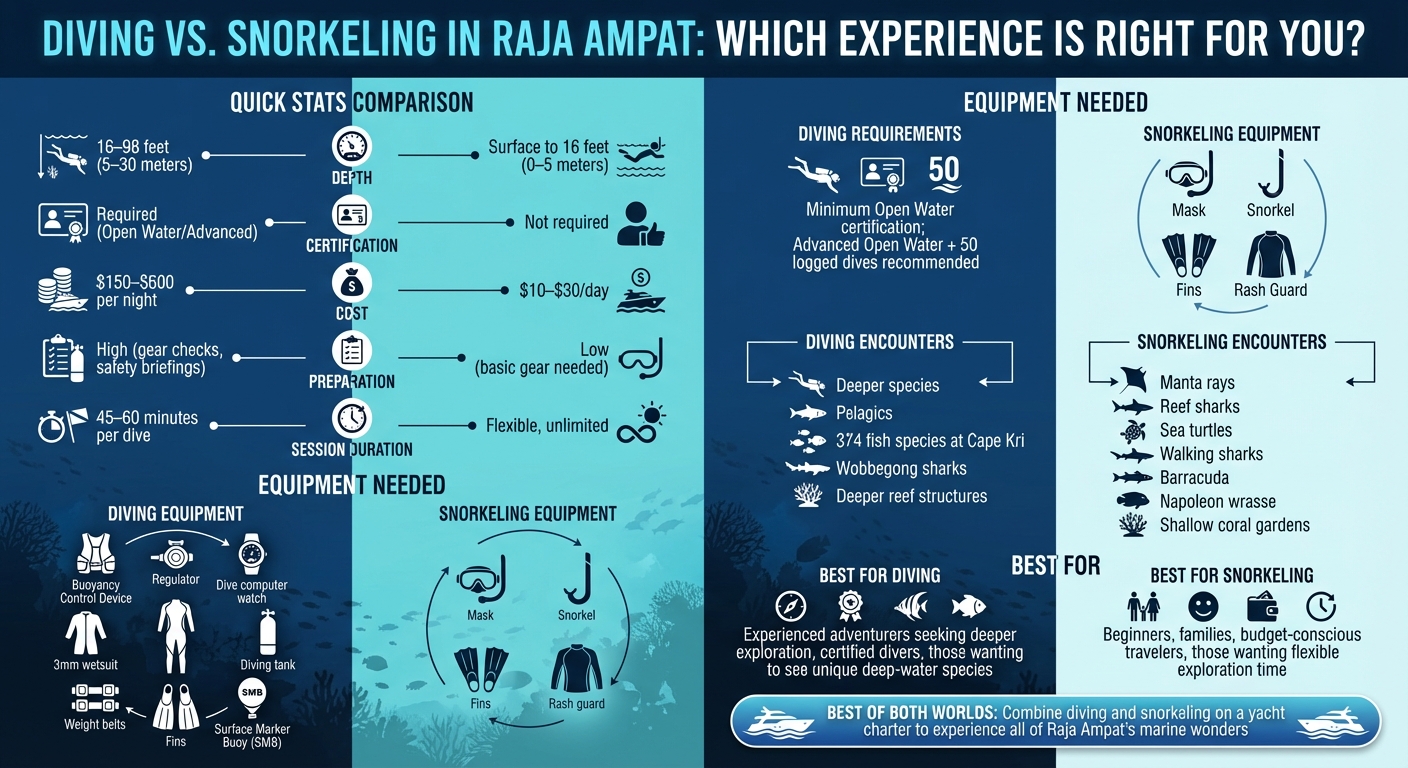
Diving vs Snorkeling in Raja Ampat: Complete Comparison Guide
Journey to Raja Ampat 🇮🇩: Explore Kri Island’s Underwater Paradise
Diving in Raja Ampat: What to Expect
Diving in Raja Ampat takes you far beyond the simplicity of snorkeling, offering a technical journey through some of the most diverse underwater landscapes on Earth.
What Makes Diving Here Different
Raja Ampat lies at the heart of the Coral Triangle, a region often described as the “bull’s eye” of marine biodiversity. Diving here means immersing yourself in waters teeming with life. At Cape Kri, for instance, an astonishing 374 to 376 fish species have been recorded on a single dive [10]. It’s a kaleidoscope of colors, movement, and marine life that feels almost otherworldly.
This incredible biodiversity stems from the Indonesian Throughflow, the planet’s largest seawater movement. These nutrient-packed currents nourish the reefs and spread larvae across the area, creating a habitat for species you won’t find anywhere else. Among the highlights are the quirky Epaulette shark that “walks” on the reef, along with rare mantis shrimp and endemic corals [7][8][10].
The underwater terrain is just as varied as the marine life. You’ll encounter everything from towering seamounts and steep walls to blue-water mangroves where soft corals thrive [9][10]. The water temperature remains a warm 82–86°F (28–30°C) year-round, with visibility ranging from 50 to 100 feet [6][9][10]. A 3mm wetsuit or rash vest is usually all you need for comfort [10].
“There is absolutely nothing else that compares! Our surveys reveal that this region is the richest on the planet for reef fishes. The Raja Ampat islands are situated in the midst of a ‘biological crossroad’ and the result of this is a lavishly rich reef fish fauna that has no equal.” – Dr. Gerald Allen, Ichthyologist [8]
However, the unique conditions in Raja Ampat also demand advanced diving skills, as outlined below.
Required Skills and Certifications
While beginners can dive here, the more iconic sites, like Shadow Reef and Cape Kri, require an Advanced Open Water (AOW) certification. These spots often feature depths of 98 to 131 feet (30 to 40 meters) and strong currents [10]. Most liveaboard operators recommend having at least 50 logged dives for confidence and control, though some accept divers with 30 logged dives and an Advanced certification for calmer areas [2][11].
If you’re less experienced, land-based resorts in the Dampier Strait provide access to house reefs and shallower dive sites, which are more beginner-friendly than remote liveaboard itineraries [2]. To prepare for Raja Ampat’s conditions, consider taking a PADI Boat Diver or Drift Diver specialty course before your trip [12]. Dive insurance is a must, as emergency evacuation options are limited, though a hyperbaric chamber has been operational at the TNI AL Hospital in Sorong since 2025 [2].
With the right training and preparation, you’ll be ready to take on Raja Ampat’s thrilling underwater challenges.
Challenges and Safety
Diving in Raja Ampat isn’t without its challenges. Strong currents are a hallmark of the region, with sites like Cape Kri, Blue Magic, and Mike’s Point offering “washing machine” conditions, drift dives, and unpredictable up-and-down currents [2][5][11]. At The Passage, whirlpools can be so intense that divers often wait for calmer conditions before entering [2]. Mastering buoyancy is essential to protect the delicate corals while navigating these dynamic waters.
“Famous dive sites like Cape Kri, Blue Magic, and Mike’s Point, to name a few, can have pounding currents that are not to be taken lightly.” – Brett Robertson, PADI Platinum Course Director [5]
Safety gear is critical. A Surface Marker Buoy (SMB) helps ensure safe boat pickups after drift dives [5]. Many divers also use reef hooks to stay in place during strong currents without damaging the reef or exhausting themselves [11]. Dive times are usually capped at 60 minutes to avoid decompression risks, especially given the remote location [5]. A dive computer is essential for tracking depth and time, and a Nitrox certification can provide added safety and extended bottom time [5].
With these preparations, you’ll be equipped to explore Raja Ampat’s challenging yet awe-inspiring underwater world.
Snorkeling in Raja Ampat: Easy Access and Surface Views
Snorkeling is one of the simplest ways to experience the underwater beauty of Raja Ampat. Forget certifications or heavy gear – grab a mask, snorkel, and fins, and you’re ready to explore some of the planet’s most vibrant marine ecosystems. While diving takes you deeper, snorkeling offers an immediate and accessible window into this aquatic paradise. Let’s dive into why snorkeling is a great choice, the incredible marine life waiting just below the surface, and some essential safety tips to keep in mind.
Why Snorkeling Is for Everyone
Snorkeling is as beginner-friendly as it gets. If you can swim and have basic gear, you’re good to go. You don’t need certifications, dive tables, or tanks – just a willingness to explore. Many resorts and accommodations in Raja Ampat make it even easier, offering house reefs that start right at the beach or jetty. That means you can literally step into the water and start exploring without waiting for a boat or navigating complicated logistics.
The shallow reefs here often begin at just 5 feet (1.5 meters) deep, making them perfect for extended snorkeling sessions. You can float around for an hour or more without worrying about air supply or decompression limits. Plus, if scuba diving is on your bucket list, snorkeling is a great way to ease into the underwater world.
“Snorkeling is also the perfect way to get comfortable in the water if you are thinking about getting certified as a diver.” – Papua Paradise Eco Resort
Marine Life Just Below the Surface
Once you’re in the water, you’ll quickly realize why Raja Ampat is a dream destination for marine enthusiasts. The shallow reefs are teeming with life, thanks to the sunlight that nourishes the corals and supports a thriving ecosystem. Most of the action happens at depths of 50 feet (15 meters) or less, meaning snorkelers can enjoy a front-row seat to the marine show.
Expect to see blacktip reef sharks cruising by, hawksbill and green sea turtles gliding gracefully, and even the quirky Raja Epaulette “walking” shark, which is found only in this region. Schools of barracuda, bigeye jacks, and batfish swirl in mesmerizing patterns, while larger species like Napoleon wrasse and bumphead parrotfish patrol the reefs. Manta rays are a common sight at cleaning stations, and if you’re lucky, you might even spot a dugong grazing in the seagrass near Batanta Island.
The corals are just as spectacular as the marine life. Hard coral plateaus, fringing reefs, and vertical walls are decorated with soft corals and sea fans in every color imaginable. For a unique experience, explore the blue water mangroves, where tree roots create a magical underwater labyrinth that shelters juvenile fish and nudibranchs. A simple lycra rash guard is usually enough to keep you comfortable while you take it all in.
“Virtually everything you can see diving in Raja Ampat can also be found at snorkeling depths.” – Stay Raja Ampat
Tips for Safe Snorkeling
While Raja Ampat’s shallow waters are inviting, the currents can sometimes be strong. Always wear fins to help you stay in control, and keep an eye on your position relative to the shore or your boat. Some areas may look walkable at low tide, but shifting tides can quickly bring strong currents to these shallow passages.
Protect yourself and the environment by using reef-safe sunscreen or wearing a lycra rash guard. Avoid touching or stepping on coral to prevent injuries and preserve the fragile ecosystem. Staying hydrated is also crucial – tropical conditions can be draining, so drink plenty of water between snorkeling sessions.
If you’re unfamiliar with the area, hiring a local guide is a smart move. They can help you navigate tricky currents, ensure your safety, and point out hidden treasures like wobbegongs and pygmy seahorses that you might otherwise miss.
Best Dive Sites vs. Best Snorkel Spots
Raja Ampat’s waters promise unforgettable experiences for both divers and snorkelers. With a mix of world-class dive sites and stunning snorkeling spots, there’s something for every underwater enthusiast.
Top Dive Sites
Cape Kri is renowned for its incredible biodiversity, holding the world record with 374 fish species recorded in a single dive [17][19]. Divers can expect to encounter massive schools of jacks, snappers, and batfish, as well as sightings of Napoleon wrasse and reef sharks. Depths range from 16 to 98 feet (5 to 30 meters), but snorkelers can also enjoy the vibrant shallow bank between 10 and 26 feet (3 to 8 meters).
“Cape Kri… holds the world record for the highest number of species on one site.” – Mikumba Diving [15]
Blue Magic features a pinnacle reef that serves as a cleaning station for oceanic manta rays. This site, ideal for experienced divers, offers depths of 33 to 98 feet (10 to 30 meters) and is teeming with marine life like barracuda, tuna, and wobbegong sharks circling the reef [15][16].
The Passage is a unique, river-like channel between Gam and Waigeo Islands. With underwater caves, tunnels, and grottos set against a mangrove backdrop, it creates an almost jungle-like diving experience. Depths here can reach up to 115 feet (35 meters).
“The Passage… resembles a river flowing between the two islands, creating a strange and distinctive feeling of diving in a jungle river.” – Mikumba Diving [14]
Melissa’s Garden is a haven for coral lovers, boasting expansive fields of hard corals like table, staghorn, and brain corals. At depths of 16 to 59 feet (5 to 18 meters), this site is a favorite for macro photographers, often spotting pygmy seahorses hiding among the coral branches [16].
For snorkelers, the vibrant shallow areas of these dive sites also offer plenty to explore.
Top Snorkel Spots
Yenbuba Jetty is perfect for families and beginners, with shallow waters ranging from 3 to 16 feet (1 to 5 meters). The area is brimming with life, including giant clams, sweetlips, and even large pelagic species like barracuda and jacks cruising near the surface [17][19].
Arborek Jetty is another standout, famous for the dense schools of fish beneath the village pier. With easy shore access and shallow waters, it’s ideal for long snorkeling sessions. Giant clams and other marine life make this spot a favorite [17][16].
Friwen Wall offers a vertical snorkeling experience, with colorful soft corals, sponges, and nudibranchs visible from the surface. The wall drops dramatically from 5 feet (1.5 meters) to over 900 feet (274 meters), but the most vibrant coral growth thrives in the sunlit upper layers [17][19].
Manta Sandy is a shallow cleaning station where snorkelers can often spot manta rays gliding through the water. While visibility can sometimes vary, the chance to see these majestic creatures makes it a must-visit [17][18].
The Gam Mangroves provide a unique snorkeling experience with clear, shallow waters and fascinating marine life like archerfish, walking sharks, and nudibranchs weaving through the mangrove roots [13][9].
Raja Ampat truly offers a blend of underwater adventures, whether you’re diving into the depths or exploring the lively shallows. Each spot has its own charm, ensuring there’s something for everyone.
Equipment, Costs, and Preparation
When it comes to diving and snorkeling in Raja Ampat, the gear, costs, and preparation involved couldn’t be more different. Let’s break it down.
For snorkeling, you’ll need just the basics: a mask, snorkel, fins, and maybe a rash guard for sun protection. Diving, on the other hand, is a whole different ballgame. It demands a full kit, including a buoyancy control device (BCD), regulator, dive computer, 3mm wetsuit, tank, weights, and a Surface Marker Buoy (SMB) to handle those strong currents. Naturally, this means diving requires more prep time and comes with a higher price tag.
“You won’t need more than a 3mm wetsuit for diving here. There is no thermocline and the temperature is constant at any depth.” – The Introvert Traveler [2]
Cost Breakdown
Diving in Raja Ampat isn’t cheap. Liveaboard experiences can range from $200 to $600 per night, depending on how luxurious the boat is, while dive resorts offer packages for $150 to $400 per night. Don’t forget the Marine Park entry fee, which is around $54 USD. If you’re diving, you’ll also need specialized insurance for emergencies, as the nearest hyperbaric chamber is in Sorong [2].
Snorkeling, by comparison, is far more budget-friendly. Many resorts include snorkeling as part of your stay, and if you need to rent gear, it’s just $10 to $30 a day.
Skill Requirements
Diving in Raja Ampat isn’t for beginners. You’ll need at least an Open Water certification, though an Advanced Open Water certification with about 50 logged dives is highly recommended. The area’s strong currents and remote dive sites make experience essential. Snorkeling, however, is much more accessible – basic swimming skills are all you need [2].
Diving vs. Snorkeling: A Quick Comparison
| Factor | Diving | Snorkeling |
|---|---|---|
| Equipment Needed | BCD, regulator, dive computer, 3mm wetsuit, tank, weights, fins, SMB | Mask, snorkel, fins, rash guard |
| Certification Required | Yes (minimum Open Water; Advanced recommended) | No |
| Typical Costs | $150–$600 per night (inclusive packages) | $10–$30 per day (gear rental) or included in stay |
| Depth Range | 16–98 feet (5–30 meters) | Surface to 16 feet (0–5 meters) |
| Session Duration | 45–60 minutes per dive | Flexible, unlimited |
| Prep Complexity | High (gear checks, safety briefings, kitting up) | Low (grab and go) |
| Current Management | Requires reef hooks, SMBs, and drift diving skills | Minimal; best in sheltered bays |
Diving involves meticulous preparation – equipment checks, verifying air or nitrox, and safety briefings before every dive. If you’re on a luxury liveaboard, the crew will usually help with gear assembly [20]. Snorkeling, in contrast, is as simple as grabbing your gear and heading to the water, especially if your resort has a house reef you can access right from the shore [3].
Each activity offers a unique way to explore Raja Ampat’s marine wonders, but the commitment and costs differ drastically.
Best Time to Visit and Getting There by Yacht
The dry season, lasting from October to April, is when Raja Ampat is at its best. During this time, underwater visibility can reach an impressive 82 to 98 feet (25–30+ meters), and the sea conditions are at their calmest – especially between November and March [22][23]. Water temperatures hover comfortably between 82–86°F, making it perfect for diving and snorkeling [22][24]. If spotting manta rays is on your bucket list, aim for a trip between December and February. During these months, mantas gather at cleaning stations in Central Raja Ampat and Misool, offering unforgettable encounters [22][16].
For those looking to avoid the peak-season crowds while still enjoying great weather, October and April are excellent shoulder months [23][16]. The seas remain calm, and visibility is still solid at 66–82 feet (20–25 meters), but with fewer boats around. On the flip side, the wet season from May to September brings choppier seas and reduced visibility. Conditions are particularly rough from June through August when the winds are strongest [22][24]. These seasonal patterns make exploring Raja Ampat by yacht an unbeatable choice, especially during the dry season.
A yacht charter transforms your Raja Ampat experience. Unlike land-based accommodations, which are limited to exploring a 12–19 mile (20–30 km) radius, a yacht allows you to cover the entire 15,444 square mile (40,000 square kilometer) archipelago in one trip [5][3]. Asia Global Yachting offers direct pickup from Sorong harbor, eliminating the hassle of complicated transfers. The yacht travels overnight, so each morning you wake up to a fresh reef ready for exploration. This approach ensures you can fully enjoy Raja Ampat’s incredible marine diversity, whether you’re diving or snorkeling.
“A private yacht charter… provides the flexibility to find less crowded dive sites and ensure a more intimate experience.” – Yacht Charter Indonesia [16]
Asia Global Yachting takes care of all the logistics, from marine park entry permits to airport transfers. Onboard, you’ll find professional dive guides, gourmet meals prepared by private chefs, and satellite communication for safety in remote areas [25][26]. Luxury dive boats start at $4,500 per day, while superyachts can cost upwards of $15,000 per day [25]. Plan ahead and book 6–9 months in advance for the peak season (December–March), as the top vessels are in high demand [22].
Choosing Between Diving and Snorkeling
Deciding whether to dive or snorkel in Raja Ampat comes down to your skills, physical condition, and the kind of marine life you’re hoping to see. Certified divers with experience can explore the region’s deeper walls and pinnacles, while snorkeling offers a more relaxed experience that doesn’t require certifications. Both options unlock Raja Ampat’s incredible marine biodiversity, but your budget might also influence your choice. Diving involves costs for specialized gear – like BCDs, regulators, dive computers, and tanks – along with mandatory insurance and certification fees [4][21]. Snorkeling, on the other hand, is much more affordable, requiring only a mask, snorkel, and fins [4].
Luckily, many of Raja Ampat’s reefs are shallow, starting at just 10–13 feet (3–4 meters). This means snorkelers can still encounter majestic manta rays, reef sharks, and turtles without missing out on the action [4]. The simplicity and lower cost of snorkeling make it an appealing option, especially when combined with occasional dives during a yacht charter.
“Resorts also work beautifully for mixed groups: while you’re diving, your partner can snorkel or simply relax on board.” – Ocean Earth Travels [3]
For the best of both worlds, consider combining diving and snorkeling on a yacht charter. With Asia Global Yachting, for instance, you can dive at iconic sites like Cape Kri in the morning and snorkel at Arborek Jetty in the afternoon – all from the same vessel [13][16]. This setup is perfect for families or groups with mixed experience levels. Everyone can enjoy Raja Ampat’s underwater treasures, regardless of certification. Plus, yachts are equipped with everything you need, from dive gear to snorkeling sets, and guided by professionals who ensure safety and monitor conditions [3][4].
If your focus is on extensive diving, especially in areas like the Northern Dampier Strait or Southern Misool, a liveaboard trip with 3–4 dives per day is ideal [3]. For those seeking a slower pace, snorkeling offers flexibility without sacrificing access to Raja Ampat’s marine wonders [1][4]. Whichever you choose, tailor your adventure to your preferences and skill level for a truly unforgettable underwater experience.
FAQs
Can I do both diving and snorkeling on the same Raja Ampat trip?
Yes, it’s absolutely possible to enjoy both diving and snorkeling during a trip to Raja Ampat. The area is a haven for marine enthusiasts, offering stunning opportunities for both activities, often just a short distance apart. Snorkelers can marvel at colorful coral reefs and abundant marine life in the shallows, while divers can explore deeper waters to encounter larger marine species. Many dive resorts and liveaboards are equipped to accommodate both divers and snorkelers, ensuring you can experience the best of what Raja Ampat has to offer.
Which Raja Ampat areas are safest for beginners in currents?
For those just starting out, the central Dampier Strait in Raja Ampat is a fantastic choice. The waters here are calm and warm, with excellent visibility, making it perfect for beginners. Shallow reefs in the area provide an easy and enjoyable diving experience, and many dive operations cater specifically to novice divers. However, steer clear of spots with strong currents unless you’re with a skilled instructor, as these conditions can be tricky – even for seasoned divers.
How many days do I need to see mantas and top reefs?
To experience the stunning mantas and vibrant reefs of Raja Ampat, plan to spend 4 to 7 days in the area. This timeframe allows you to visit legendary manta spots like Manta Sandy and explore breathtaking reefs in places such as Misool and the Dampier Strait. Scheduling multiple dives or snorkeling trips increases your chances of spotting mantas, as their presence often depends on the season and weather conditions.