

Articles
Why longtail boats are popular in Thailand

Thailand’s longtail boats, known as ruea hang yao, are a practical solution for navigating the country’s shallow waterways, narrow canals, and coral-filled coastal regions. First introduced in the 1930s, these boats combine a lightweight wooden hull with a repurposed automotive engine mounted on a long, adjustable shaft. This design allows them to operate in water as shallow as 1 foot, making them perfect for fishing, transporting goods, and ferrying passengers, especially in areas lacking maritime infrastructure.
Here’s why they remain indispensable:
- Shallow Water Navigation: Their design enables operation in minimal water depth, avoiding damage from reefs, sandbars, and debris.
- Cost-Efficiency: Built with salvaged engines, they are affordable to construct and repair.
- Cultural Significance: Decorated with colorful sashes and flowers, they honor Mae Ya Nang, believed to protect passengers.
- Tourism Appeal: They provide access to secluded beaches, lagoons, and caves, offering travelers a glimpse into local life.
Longtail boats are not just functional – they are a lifeline for local communities and a key part of Thailand’s identity.
Transportation Challenges in Thailand’s Waterways
Geographic and Navigation Problems
Thailand’s waterways present unique challenges that make conventional boats impractical. Many rivers, canals, and coastal areas have water depths of less than 3.3 feet, which often causes standard outboard motors to scrape along the riverbed or damage their propellers. The narrow canals, locally known as klongs, wind through urban areas like Bangkok and coastal regions such as Krabi, demanding vessels with sharp maneuverability[8].
Coastal navigation is equally tricky. Coral reefs, sandbars, and limestone karsts create natural barriers, preventing deep-draft boats from approaching shorelines or accessing lagoons. Journalist Daniel Allen explained this well in CNN:
With their narrow profile and negligible draft, long-tail boats are ideal for navigating the shallow bays, creeks, caves and passageways of Krabi’s picturesque marine environment[2].
This makes standard speedboats unsuitable for such environments, as they risk severe damage when attempting to access these shallow or obstructed areas.
Other obstacles include dense vegetation, mud, silt, and submerged debris, all of which can clog conventional cooling systems and damage fixed propellers. Adding to these difficulties are tidal fluctuations – what might be an accessible beach at high tide can turn into a dry expanse hundreds of yards from the water at low tide[10]. Compounding these challenges is the lack of extensive maritime facilities along Thailand’s coasts, leaving many areas difficult to navigate with traditional vessels.
Limited Infrastructure in Coastal Regions
Coastal regions and islands in Thailand often lack essential maritime infrastructure. Many areas have no piers, docks, or deep-water jetties, forcing vessels to load and unload directly from the shore. This fragmented geography makes watercraft a critical – sometimes the only – means of transporting goods, passengers, and vital supplies.
Conventional boats struggle in these conditions because their fixed engines require deeper water. Longtail boats, however, are specifically designed to handle these challenges. With an extended propeller shaft measuring between 6.6 and 13 feet, they can operate in water as shallow as 1 to 1.6 feet. Operators can tilt the propeller upward, allowing the boats to glide over sandbars and muddy patches where other vessels would get stuck[8]. This adaptability explains why longtail boats remain the go-to choice for navigating Thailand’s intricate and often unforgiving waterways.
How Longtail Boats Solve Transportation Problems
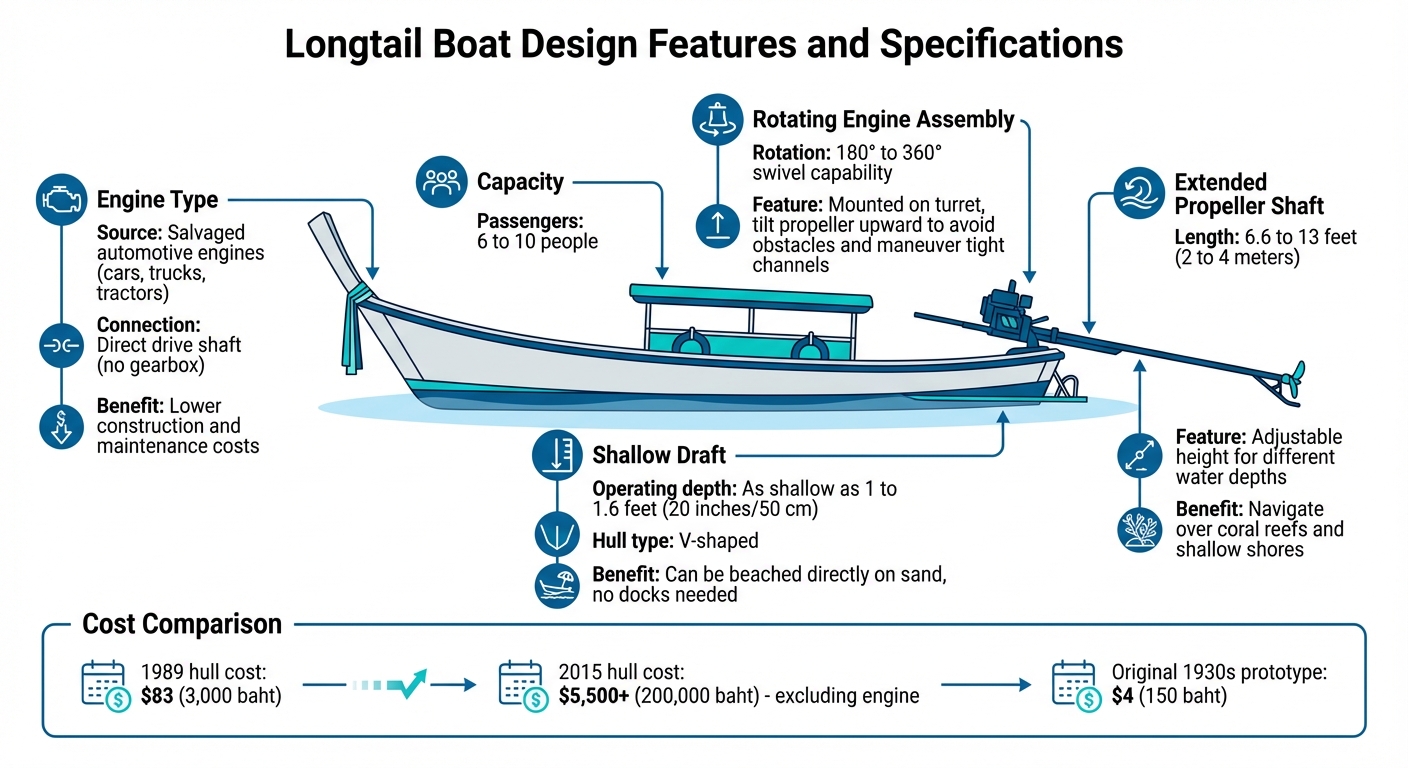
Longtail Boat Design Features and Specifications
Design Features
One of the standout features of longtail boats is their extended propeller shaft – typically over 6.6 feet (2 meters) long – that stretches out behind the boat[4]. This design isn’t just for show; it allows operators to adjust the propeller’s height to handle different water depths. Whether navigating over coral reefs or cruising through shallow shores, this flexibility makes these boats incredibly versatile.
The engine assembly sits on a rotating turret capable of swiveling a full 180° to 360°. This allows operators to tilt the propeller upward, making it easier to maneuver through tight channels or avoid underwater obstacles[1].
The hull design adds to this versatility. Most longtail boats feature a V-shaped hull, which helps them cut through waves while maintaining a shallow draft. This shallow draft means the boats can be beached directly on sand, eliminating the need for docks or piers.
Cost and Efficiency
Longtail boats aren’t just practical; they’re also built for affordability. Instead of pricey marine motors, they use salvaged automotive engines from cars, trucks, or even tractors. This setup, combined with a simple direct connection between the propeller and drive shaft, removes the need for costly gearboxes. The result? Lower construction and maintenance expenses[1].
Repairs are also easy to handle since parts for these engines are widely available across Thailand. As Bang Bao, a boatbuilder, puts it:
Nobody here uses plans. Everything is done by eye. My father taught me everything I know.[12]
In 1989, a new hull cost around $83 (3,000 baht). But after the 1989 logging ban on natural forests caused timber prices to skyrocket, the price of a hull jumped to over $5,500 (200,000 baht) by 2015 – excluding the engine[1]. Even with these increased costs, longtail boats remain a cost-effective choice, especially for operators navigating shallow-water routes where their unique design is indispensable.
The combination of clever engineering and affordability has solidified the longtail boat’s role as a cornerstone of Thai maritime life.
History and Craftsmanship of Longtail Boats
Origins and Development
Back in the 1930s, Sanong Thitibura, a helmsman for the Thai royal family, revolutionized water transportation in Thailand with a simple yet transformative idea: attaching an engine to a traditional rowing boat and extending its propeller shaft[1]. This early innovation cost just about $4 (150 baht) to build[8], making it an affordable option for fishermen and traders in need of motorized transportation.
Over the years, boat builders like Sucheep Ratsarn and Chanchai Phairatkhun took Thitibura’s design and refined it further[1]. The result was the ruea hang yao – the longtail boat – that became an indispensable part of life on Thailand’s rivers and coasts. These boats weren’t just practical; they became symbols of Thailand’s maritime culture[14][2].
Longtail boats even found international fame in the 1974 James Bond movie The Man with the Golden Gun, where they were featured in a thrilling chase through Bangkok’s canals[1].
Building Methods and Craftsmanship
The longtail boat’s legacy is upheld by traditional craftsmanship, rooted in techniques passed down through generations[9][15]. Bang Bao, a boatyard owner in Krong Rua, describes the process:
Nobody here uses plans. Everything is done by eye. My father taught me everything I know[2].
Aspiring boatbuilders typically spend three to four years as apprentices. Construction starts with the keel and moves through the bow, stern, and outer planks[2]. A single boat, crafted by a team of three or four people, takes about two months to complete[2]. To waterproof the boats, builders soak cotton string in resin from breadfruit trees and carefully press it into the seams between planks[2].
Bundit Kunpoh, who leads the Ban Pak Rha Community Centre for Boatbuilding, reflects on his journey:
I started learning to make boats from my father when I was 10… I decided I wanted to use the skills he gave me to keep the traditional boatbuilding industry alive. Seeing my finished work on the water makes me proud. Proud to be my father’s son and proud to be Thai[5][2].
This commitment to tradition goes beyond craftsmanship. Longtail boats are often adorned with colorful sashes and flower garlands to honor Mae Ya Nang, the “Grandmother of Boats”, believed to safeguard the vessel and its passengers[2][11]. The enduring techniques and spiritual significance tied to these boats ensure they remain a vital part of Thailand’s maritime heritage.
Longtail Boats in Tourism and Luxury Travel
Tourism in Coastal and Island Destinations
Longtail boats play a key role in Thailand’s island tourism, making it possible to reach hidden lagoons, narrow waterways, and untouched beaches. Thanks to their shallow draft, which can navigate waters as shallow as 20 inches (50 centimeters), these boats provide access to intimate coastal spots that are often off the beaten path.
In popular destinations like Koh Phi Phi, Koh Hong, and Phang Nga Bay, longtail boats act as water taxis, offering flexible and personalized itineraries. Their flat-bottom design allows them to land directly on sandy beaches, bypassing the need for piers. This makes it easy for visitors to step off at remote gems like Railay Beach, Phra Nang Cave Beach, and the famous “4 Islands” in Krabi – Chicken, Poda, Tup, and Mor.
Designed to accommodate 6 to 10 passengers, these boats are more than just functional. Their traditional decorations, inspired by the revered Mae Yanang, add a distinctive charm that appeals to tourists and creates stunning photo opportunities:
“A trip to Thailand’s islands isn’t complete without a ride on a longtail boat. It’s not just a means to an end – it’s an immersive experience into Thai local life, engineering ingenuity, and coastal culture.”
To make the most of these trips, it’s best to schedule excursions early in the morning or late in the afternoon. This helps avoid the midday heat and crowds at popular spots like James Bond Island. Beyond their role as water taxis, longtail boats have also become a key part of luxury travel, offering elevated experiences for discerning travelers.
Combining Longtail Boats with Luxury Yacht Charters
Longtail boats, with their rich heritage and practical design, are now blending seamlessly into the world of luxury yacht charters. While maintaining their traditional wooden aesthetic, many modern longtail boats are equipped with premium features like cushioned seating, dining spaces, onboard toilets, and dedicated crew services.[17]
For guests on luxury yachts, longtail boats act as perfect tenders, navigating coral-filled shallows and tight passages that larger vessels cannot access. They enable unique experiences like private snorkeling trips and gourmet picnics at serene locations such as Rang and Khai Islands.[16]
Private charters for half-day trips to Rang and Khai Islands typically cost between $302 and $402 (10,900 to 14,500 THB), while full-day sunset trips to Phi Phi Island are priced around $579 to $623 (20,900 to 22,500 THB). These packages often include private crews and full catering, turning the traditional longtail boat into a luxurious day cruiser, all while preserving its cultural essence.[16][17]
For travelers who want to combine comfort with an authentic Thai experience, adding longtail boat excursions to a yacht itinerary offers a perfect balance. However, safety should always come first – make sure operators provide life jackets and follow established safety protocols.[9]
Conclusion: Why Longtail Boats Remain Popular
Longtail boats have cemented their place in Thailand by excelling where modern vessels often fall short. With their slim build and shallow draft, they can glide through waters as shallow as 20 inches, effortlessly reaching coral-filled bays, narrow caves, and hidden beaches that speedboats simply can’t access. Their unique design – featuring an adjustable propeller and an engine capable of rotating 180° to 360° – makes them incredibly agile. This combination of adaptability and affordability ensures they remain a cornerstone of Thailand’s maritime traditions [1][7].
But their importance goes beyond technical features. Longtail boats are a lifeline for many local communities. Powered by second-hand car or truck engines, they are far cheaper to maintain than marine engines and easy to repair using locally available parts [11]. Many families rely on these boats for both fishing and transporting tourists, keeping tourism income within the community [6][12].
Their cultural value is equally profound. Each boat is more than just a vessel; it’s a reflection of pride and tradition. Master craftsman Bundit Kunpoh expresses this sentiment perfectly:
Seeing my finished work on the water makes me proud. Proud to be my father’s son and proud to be Thai.
Decorated with colorful scarves and garlands at the bow, these boats pay homage to Mae Yanang, the goddess of journeys, blending spiritual beliefs with everyday life [12].
For travelers, longtail boats offer more than just a ride – they provide a window into Thailand’s rich maritime heritage. Their ability to navigate narrow limestone caves and untouched beaches offers a rare experience where traditional craftsmanship meets functional brilliance.
Since their introduction in the 1930s, longtail boats have remained indispensable. They are cost-effective, deeply tied to local culture, and perfectly suited to Thailand’s coastal geography. Serving both local needs and high-end tourism, they continue to be a vital part of the nation’s maritime identity [1].
FAQs
Are longtail boats safe to ride?
Longtail boats in Thailand are a common and iconic mode of transport, known for their craftsmanship and frequent use by both locals and tourists. When properly maintained and operated by experienced boatmen, they are generally considered safe.
To ensure a secure journey, passengers should always wear life jackets, adhere to local safety guidelines, and opt for operators with a good reputation – particularly during rough weather. The boat’s condition and the skill of its operator play a crucial role in guaranteeing a safe and enjoyable ride.
Why are longtail boats better than speedboats in shallow areas?
Longtail boats excel in shallow waters thanks to their narrow build and minimal draft. This design lets them glide effortlessly through coastal shallows, bays, and rivers, making them perfect for reaching spots where speedboats might face challenges or risk getting stuck.
How much does it cost to charter a private longtail boat in Thailand?
Chartering a private longtail boat in Thailand usually costs between $50 and $100 USD per hour. The exact price depends on factors like the location, how long the trip lasts, and any specific arrangements you make.